
Building the Foundation
Introduction
Why your business case matters
Providing high-quality population-based primary care requires a team and sustainable financing right from the start to ensure success. A clear understanding of your unique business dynamics contributes to your financial wellbeing and aids you in taking advantage of new opportunities to create revenue while navigating around challenges like rising healthcare salaries.
At the heart of the Population Health Management Initiative (PHMI) work in this domain is the Business Case Tool. This guide enables a multidisciplinary team of leaders within a community health center to model various approaches to care and anticipate the financial outcomes with a reasonable amount of certainty for individual clinical sites. Although this guide is designed especially for the unique payment considerations of health centers, working through your business case is important for all primary care practices.
Using the Business Case Tool, a health center can monitor the financial health of their population health management model throughout implementation by comparing actuals to projected outcomes and intervene early when the data indicates that modifications to the approach are needed. Additionally, the business case tool serves as a template for calculating return on investment and deciding whether to implement the PHMI model of care in additional sites and/or expand its scope in the pilot site(s).
For talking points to help staff and other stakeholders understand the importance of the change, see Building the Foundations: Talking Points for Engagement. Understanding the bigger picture helps care teams move from viewing population health areas as isolated requirements to seeing them as part of a long-term strategy for improving patient outcomes and practice sustainability.
How to use this guide
These guides are designed to be helpful as part of an organized quality improvement strategy, with the goal of supporting substantive cultural, technological and process changes that improve population-based care.
Enterprising practices can take on this work on their own with internal champions, including quality improvement, clinical and program leaders. They are often supported by practice facilitators, coaches or external consultants who help primary care practices improve population health management.
The central content of the guide is organized into a sequenced set of evidence- or best practice-based key activities that, when applied to your local clinical context, can lead to improved ways of working. An on-site leader or champion can motivate peers and adapt the content in this guide for your setting, size, patient population and context.
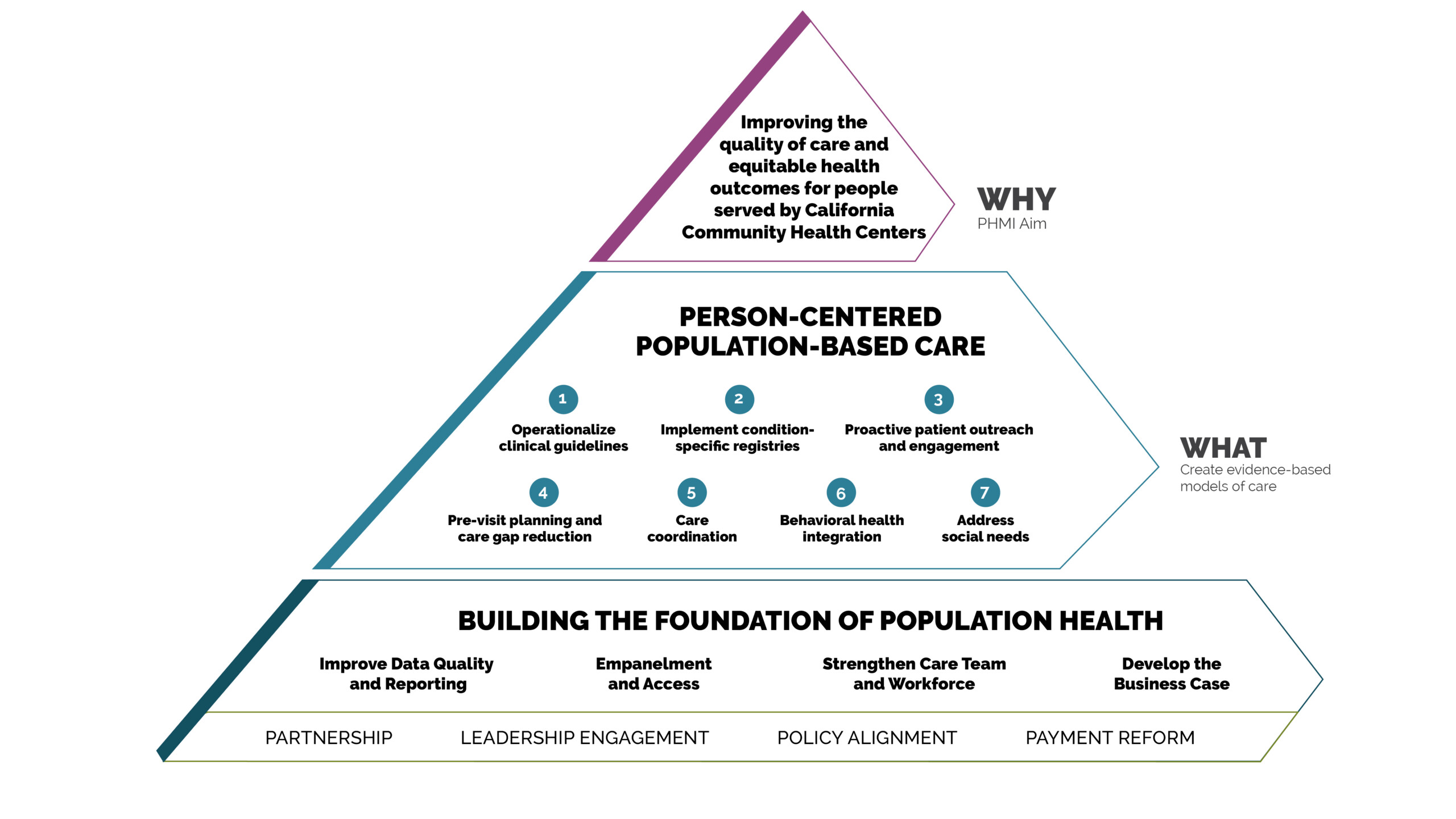
What the business case guide offers
The Business Case Guide helps organizations develop a financial model for an optimized care team to support population health management. It helps determine the expenses and potential revenues that result from investing in and implementing population health management. The guide includes adaptations for community health centers and their specific payment mechanisms. If your practice is not a health center, some parts of this guide and the accompanying tools may not directly apply to you, but can be adapted for your use.
Though the specific business case for improving population health management varies for each organization based on the patient composition and payer mix of practices, in general, the goal of this guide is to leverage high-performing care teams to proactively support patients and families in improving their health. Using provider time appropriately, reducing waste and rework, avoiding expensive emergency department visits, and leveraging value-based payment arrangements are all components of building the business case for population health management.
The Business Case Tool helps facilitate the planning for operational change. It’s a sophisticated Excel spreadsheet designed to simulate changes to primary care practice staffing and models of care in order to help estimate the resulting financial implications. Using this tool will enable a multidisciplinary team of leaders to model various approaches to care, and anticipate the financial implications with a reasonable amount of certainty.
For organizations interested in Going Deeper, additional content is available on moving further into value-based care through capitated payment or shared savings arrangements to support the adoption of new care team roles and service delivery modes. Finally, the guide covers business case topics On the Horizon.
Who needs to be involved in the work
This guide was developed specifically for community health center leadership from different disciplines (financial, clinical and operations) who are working to set goals, develop an action plan and realize it over time. Involving representatives from leadership positions across your organization in both the design of the business case and decisionmaking that impacts their work can be transformational in and of itself. We recommend you engage:
- Financial leadership, including your chief financial officer, to examine revenue and expense implications of various care team scenarios. A financial analyst can be a helpful contributor to this process.
- Clinical leadership, including your chief medical officer, but also consider key physicians, nurse practitioners, nurses and medical assistants who will likely have useful viewpoints to consider.
- Operational leadership, which may include your quality improvement director, operations manager, health information management director or your community engagement lead.
In addition to your business case, there are advantages for your operations and culture to integrating clinical and financial teams early on. This might be the first time you bring these two teams together. It is an important step in prompting a new way of thinking within your organization, and is a valuable activity within itself.
The benefits of a business case
By using the Business Case Tool, you will be able to tackle important issues and answer critical questions about the appropriate care team model as you go, including:
- Assess your current financial performance and project the financial impact of different care team models.
- How does the practice’s current care team model compare with the recommended model?
- Identify what investments are needed upfront (e.g., infrastructure costs) and what revenue sources exist for the investment.
- How much will this cost initially, and what revenue sources could you tap into in order to cover this cost?
- Quantify the financial impact of implementing your PHMI plan before doing so.
- If you go with what is recommended, what is the required upfront investment and impact to the bottom line?
- What offsets will you have from new revenue from other sources, especially value-based payments?
- What is the impact on payment for direct services?
- Consider the equity implications of budgeting decisions.
- Compare the impact of applying interventions to some patient populations (e.g., for one payer) versus all patients.
- Determine if it is financially sustainable and, if not, test modifications to the model to make it sustainable.
- What are the ongoing costs associated with implementation?
- If not sustainable, what would make it so?
- How can you adjust your model to make it sustainable, or find something the practice can live with? Remember, this is an iterative exercise!
As you build your business case, consider these revenue stream options:
- Fee-for-service Prospective Payment System (PPS).
- Proposed capitation Alternative Payment Methodology (APM).
- Enhanced Care Management (ECM) fees.
- Independent practice association (IPA) subcapitation for professional services and ambulatory diagnostics.
- Pay-for-performance with Medicaid Managed Care Organizations (MCOs) for quality HEDIS metrics.
- 340B replacement program.
- Section 330 and other federal funding.
- County funding for care of medically uninsured (some regions).
- Kaiser Permanente-funded Population Health Management Initiative (PHMI).
- Philanthropically and grant funded projects.
Although it is never too late to develop a business case, the biggest payoff comes from initiating the process during the planning phase of your initiative, and then utilizing it throughout your population health management journey to validate the projections and adjust the model over time in response to actual financial performance.
We recommend you begin developing your business case even before your population health management approach has been finalized. The power of your business case lies in the ability to help practice leadership identify a financially sustainable approach for a unique site—before committing to a specific model or set of resources.
Maintaining the tool over time will enable you to objectively monitor how the projections play out and determine the financial impact, allowing you to make midcourse adjustments.
Ideally, you build periodic assessment of your business case model and test scenarios using the Business Case Tool as part of your annual budgeting cycle.