
Building the Foundation
Introduction
Why care teams and workforce matter
Recent research shows that a single primary care provider (PCP) would need 26.7 hours in a day to provide all the evidence-based preventive, chronic illness and acute care to an average panel of patients.[1] The good news is that a single provider does not have to do it all! Team-based care when two or more healthcare professionals work collaboratively with patients and their caregivers to accomplish shared goals[2]—can help practices to deliver high-quality primary care leading to better health outcomes[3] and experiences for patients.[4]
Strengthening care teams is increasingly recognized as a critical foundation for high-performing primary care, with California Advancing and Innovating Medi-Cal (CalAIM) adding community health workers and doula services as covered benefits. Engaging nurses, behavioral health specialists, lay health workers, medical assistants and others as key partners in caring for patients increases access to behavioral health and social need services.[5] Sharing the work of primary care among a team of professionals can improve staff and provider experiences, a critical consideration in this post-COVID environment when the healthcare workforce is struggling with burnout and overwork.[6]
Creating high-performing primary care teams can be done in a range of settings, but always requires focusing on both the technical aspects of task and workflow redesign, as well as the communication and trust that binds a team together.[7] The Center for Excellence in Primary Care at University of California, San Francisco (UCSF) describes best practices of high performing team-based care, including:
- Embracing a culture shift where team members share responsibility for and contribute meaningfully to the health of their patient panel.
- Establishing efficient workflows with standard processes and team member functions.
- Effective communication that is promoted through regular team meetings, daily huddles and real-time interaction.
For talking points to help staff and other stakeholders understand the importance of the change, see Building the Foundations: Talking Points for Engagement. Understanding the bigger picture helps care teams move from viewing population health areas as isolated requirements to seeing them as part of a long-term strategy for improving patient outcomes and practice sustainability.
How to use this guide
These guides are designed to be helpful as part of an organized quality improvement strategy, with the goal of supporting substantive cultural, technological and process changes that improve population-based care. Enterprising practices can take on this work on their own with internal champions, including quality improvement, clinical and program leaders. They may be supported by practice facilitators, coaches or external consultants who help primary care practices improve population health management.
There are a lot of factors that impact an organization’s ability to create high functioning team-based care, some of which are in an organization’s control (e.g. leadership that fosters psychological safety) and others that are not (e.g. the state’s scope of practice policies). [8]
The central content of this guide is organized into a sequenced set of key activities within a practice’s locus of control. These key activities are evidence-based or best practice-based ideas that, when applied to your local clinical context, can lead to improved ways of working. How different practices apply these ideas will vary based on external factors, such as payment structure, union environment and local workforce context. An on-site leader or champion can motivate peers and help in adapting the content for your setting, size, patient population and context.
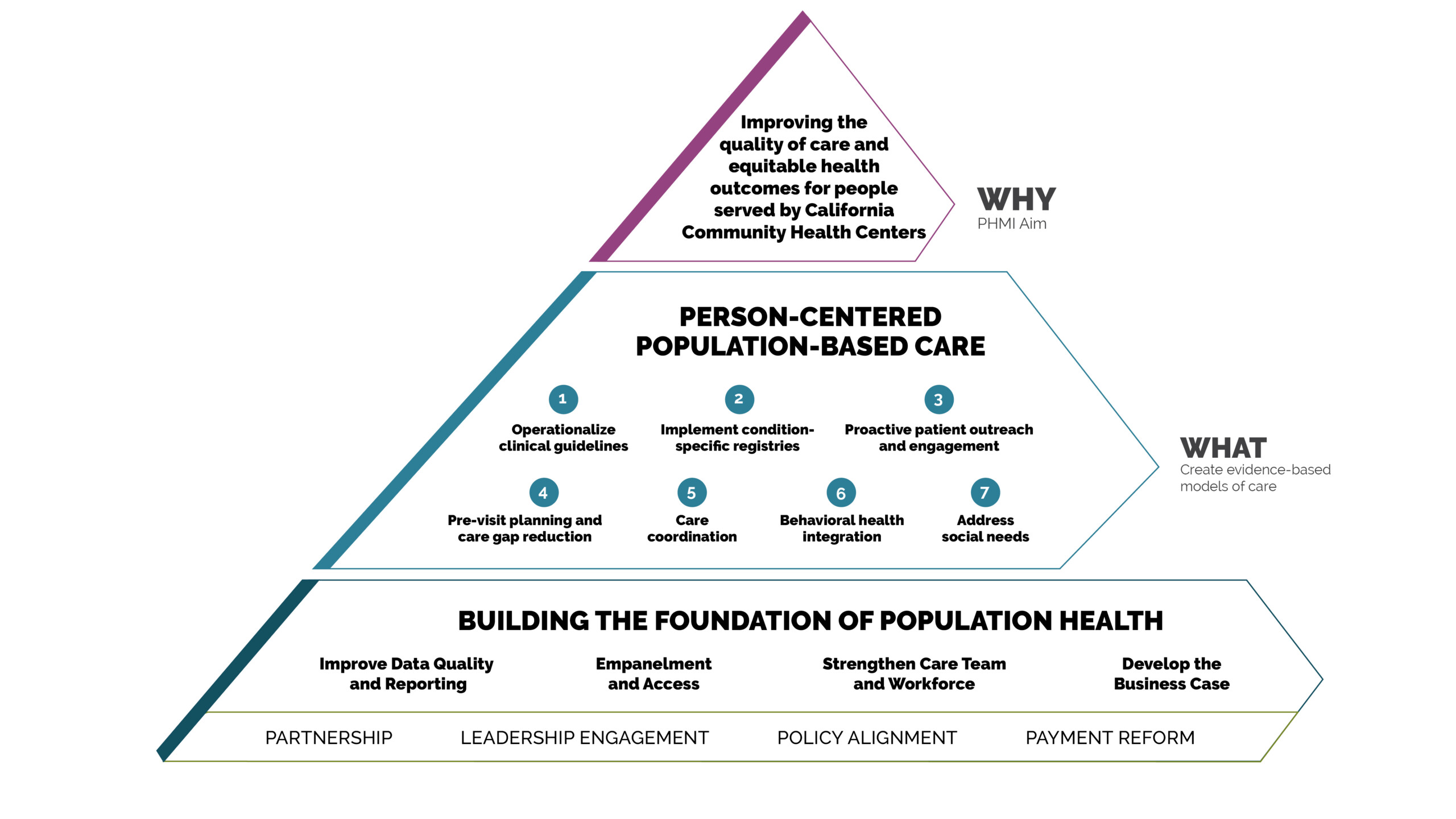
What the care teams and workforce guide offers
This guide offers a practical, tested approach to building and supporting team-based care, starting with the intentional identification of a core team of people who together can provide care for most patient needs on their panel. By centering continuous healing relationships between patients and care teams, the guide then shows how to build out the expanded care team to assure the functions of high performing primary care are in place, including a quality improvement approach. The guide offers an index model for how different care team roles can help to support those functions, including licensure and full-time equivalency (FTE) considerations.
The guide also offers ideas for how to Advance Equity through your work on care teams and workforce, and provides guidance for Supporting Change through change management strategies.
For organizations interested in Going Deeper, additional content is available on facilitating teamwork and fostering joy in work. Finally, the guide covers team-based care topics On the Horizon, such as structuring teams for virtual care and thinking about care provision outside the walls of traditional primary care clinics.
Who needs to be involved in the work
Reimagining care teams impacts everyone in a practice, as it impacts care delivery, communication, culture and budgets. Critical leadership roles needed to support an organization’s approach, include:
- Clinical leadership, like a chief medical officer, to design and support care team changes, including changes to clinical schedules and coverage arrangements.
- Financial leadership, like a chief financial officer, to examine revenue and expense implications of modifying, adding or removing care team roles.
- Quality improvement leadership, like a director of quality improvement (QI), to support cultural changes and reimagine how teams work, including fostering communication and trust.
- Human resources leadership to advocate for equitable hiring practices, understand the state’s scope of practice and licensure changes, and explore creative pipeline development, recruitment and retention strategies.
In addition to strong, aligned leadership, care team members themselves must be part of any effort to redesign care teams. Doctors, nurses, community health workers and behavioral health providers know the needs of their patients best, and have critical insights into how current role and task distribution works—or doesn’t. Care team redesign means changing what people are asked to do each day. Involving staff and providers in the design of and decision-making about their work is critical to get the best ideas and create lasting change.
Finally, patients and families should provide important input on how care teams are organized and what services should be prioritized that will best help them meet their goals for health and well-being.
Organizing care teams to support continuous, healing relationships
The primary care team comprises the “providers and staff in a practice that collaborate to provide comprehensive, high-quality services to a defined panel of patients.”[9] The licensure and training of the providers and staff who comprise the team will vary based on the needs of the panel of patients served and the workforce’s availability and organizational context. At its core, the team should be organized to accomplish key functions of high performing primary care, including:[10]
- Organized, evidence-based care.
- Social health support.
- Population health management.
- Improved access.
- Behavioral health integration.
- Medication management.
- Health education, care coordination and care management.
- Quality improvement.
How big should this team be? To preserve the benefits of relational continuity between patients, families and their care teams, the size of the team has to be manageable; patients, providers and staff have to be able to identify who makes up the team. We also know that coordination and communication overhead increases as the team size grows.[11][12][13]
By wrapping core teams and expanded care teams around patients and their families, primary care practices can deliver the many functions described above while still centering relationships, community resources and connections.
FIGURE 1: PRIMARY CARE TEAM: CORE AND EXPANDED CARE TEAMS AND THE FUNCTIONS EACH PERFORMS

The core care team includes the primary care providers and key staff who would huddle daily and spend most of their time managing the needs of a panel, which include social health and behavioral health needs.
The expanded care team members are shared across multiple care teams and serve multiple patient panels. These roles include those that focus on:
- Population health management and data analytics.
- Behavioral health consultants to support the core care team behavioral health specialists and provide behavioral health integration.
- Care coordination and care management, including health education to support self-management.
- Medication management.
- Quality improvement.
Building strong core and expanded care teams ensures practices have what they need to tackle upcoming population health management activities. It provides the foundation for a variety of proactive schedule and panel management practices, such as daily schedule scrubbing and huddling, conducting care gap outreach calls to patients with chronic conditions, and systematic identification and addressing of social and behavioral health needs.
In this guide, an index model for core and expanded teams is offered. The index model provided here draws from current best practices and evidence published in the peer-reviewed literature, primarily work done by the Agency for Healthcare Research and Quality (AHRQ) and by Dr. Ed Wagner on optimal workforce configurations that provide high-quality, comprehensive primary care.[14] Their analysis was based on data of more than 70 high performing practices that participated in several national primary care innovation programs and insight from in-depth case studies and an expert panel. Input through the collaboratively design processes and Kaiser Permanente’s experience were all considered in the model development, including identifying the index panel size of 1,250. This index model is intended as a starting point for discussion, recognizing that the heterogeneity of patient needs and organizational context naturally results in variation.
Regardless of the precise core and expanded care team composition in high-performing teams, each individual contributes their unique skills and expertise to support whole person healthcare for a panel of patients. Spreading the work of providing preventive, chronic and acute care across the care team requires each team member to work at the top of their license, and may involve reimagining traditional roles and responsibilities. When working well, care teams can describe their:
- Shared goals.
- Distinct and well defined roles and responsibilities.
- Shared standards and norms for communication and cross coverage.
- Common approach to problem solving and process improvement.
- Dedicated time to building team cohesion and collaboration.
The key activities below walk through both the technical and cultural considerations for setting up core and expanded care teams, including engaging with patients and leveraging teams to deliver and improve care.
Endnotes
- Porter J, Boyd C, Skandari MR, Laiteerapong N. Revisiting the Time Needed to Provide Adult Primary Care. J Gen Intern Med. 2023;38(1):147-55.
- American College of Physicians. Team-Based Care Toolkit. Philadelphia: ACP; [September 11, 2023]. Available from: https://www.acponline.org/practice-resources/ patient-and-interprofessional-education/team-based-care-toolkit.
- Shojania KG, Ranji SR, McDonald KM, Grimshaw JM, Sundaram V, Rushakoff RJ, et al. Effects of quality improvement strategies for type 2 diabetes on glycemic control: a meta-regression analysis. JAMA. 2006;296(4):427-40.
- Day J, Scammon DL, Kim J, Sheets-Mervis A, Day R, Tomoaia-Cotisel A, et al. Quality, satisfaction, and financial efficiency associated with elements of primary care practice transformation: preliminary findings. The Annals of Family Medicine. 2013;11(Suppl 1):S50-S9.
- Bodenheimer TS, Smith MD. Primary care: proposed solutions to the physician shortage without training more physicians. Health Aff (Millwood). 2013;32(11):1881-6.
- Willard-Grace R, Hessler D, Rogers E, Dube K, Bodenheimer T, Grumbach K. Team structure and culture are associated with lower burnout in primary care. J Am Board Fam Med. 2014;27(2):229-38.
- Coleman K. Population Health Management Recommendations, Resources, and Research. Seattle: Center for Accelerating Care Transformation, Kaiser Permanente Washington Health Research Institute; January 20, 2022.
- Population Health Management Initiative. Population Health Management Resources Sacramento.: CalAIM PHMI; [September 11, 2023]. Available from: https:// phminitiative.com/resources/.
- Coleman K, Wagner E, Schaefer J, Reid R, LeRoy L. Redefining primary care for the 21st century. Rockville, MD: Agency for Healthcare Research and Quality. 2016;16(20):1-20.
- Meyers D, LeRoy L, Bailit M, Schaefer J, Wagner E, Zhan C. Workforce Configurations to Provide High-Quality, Comprehensive Primary Care: a Mixed-Method Exploration of Staffing for Four Types of Primary Care Practices. J Gen Intern Med. 2018;33(10):1774-9.
- Wagner EH, Reid RJ. Are continuity of care and teamwork incompatible? Med Care. 2007;45(1):6-7
- Rodriguez HP, Rogers WH, Marshall RE, Safran DG. Multidisciplinary primary care teams: effects on the quality of clinician-patient interactions and organizational features of care. Med Care. 2007;45(1):19-27
- Brooks F. The mythical man-month: essays on software engineering. Boston: Addison-Wesley Publishing Co; 1975.
- Meyers D, LeRoy L, Bailit M, Schaefer J, Wagner E, Zhan C. Workforce Configurations to Provide High-Quality, Comprehensive Primary Care: a Mixed-Method Exploration of Staffing for Four Types of Primary Care Practices. J Gen Intern Med. 2018;33(10):1774-9.