
Populations of Focus
KEY ACTIVITY #6:
Develop or Refine and Implement a Pre-Visit Planning Process
This key activity involves the following elements of person-centered population-based care: operationalize clinical guidelines; pre-visit planning and care gap reduction; care coordination; address social needs.
Overview
This key activity provides guidance for how the care team can effectively and efficiently embed preventive care measures into the practice’s pre-visit planning process (PVP). Pre-visit planning is typically driven by the medical assistant with help from other care team members and includes steps taken:
- At the end of the current visit to ensure the patient understands any actions they need to take and to schedule for any follow-up.
- Prior to a scheduled appointment, to scrub the chart and identify any pre-visit tasks per the pre-visit checklist.
- The day of an appointment, during the daily huddle and before the patient sees the PCP.
Pre-visit planning can help to ensure that prevention activities are incorporated into sick visit appointments, expanding access to care and facilitating a whole-person care approach. This creates opportunities to build interventions that are responsive to patients’ and families’ needs and preferences for engaging in the health system.
Why this matters
Approximately 80% of pediatric visits last 20 minutes or less,[1] and many patients come to these visits with multiple needs. Pre-visit planning works towards optimizing a team-based approach outside of these short primary care visits so patients receive comprehensive care in alignment with the latest clinical guidelines and their own preferences.
Sick visits provide a chance for pediatric care providers to incorporate tasks of well-care visits, including:
- Health history,
- Physical developmental history,
- Mental development history,
- Physical exam, and
- Health education and anticipatory guidance.
Utilizing this intervention to improve equitable health outcomes
Pre-visit planning allows for better coordination of care. This can be particularly beneficial for patients with complex health needs, ensuring they receive comprehensive and equitable care. As your practice works to reduce any identified equity gaps, pre-visit planning is often a powerful activity for ensuring culturally relevant care as the care team partners with the patient to discuss follow-up actions.
Utilizing this intervention to help address patients’ social needs
The PVP should incorporate your practice’s process for screening and responding to social needs, including checking whether social needs screening is due. When social needs are identified the team should be clear on the pathways, both during and after visits, to address and follow up on those needs.
Technology considerations
Pre-visit planning draws upon similar technical enablers as care gap reporting, and likewise can be facilitated at the individual patient level and at the level of groups of patients coming for care by a specific team in an appointment schedule block. The format in which planning is done needs to consider the workflow and staffing model.
Relevant HIT capabilities to support this activity include electronic access to care guidelines, registries, clinical decision support, care dashboards and reports, outreach and engagement, and care management and care coordination. See Appendix D: Guidance on Technological Interventions.
Individual patient-level pre-visit planning would optimally be enabled within the EHR, provided the EHR is able to store relevant information, such as assessments, plans, orders and notes outside of a visit note. Pre-visit planning might also include use of patient-facing applications, such as portal reminders, questionnaires and self-completed screenings and assessments, which ideally would be available to the clinician and care team in the EHR.
Engagement of the expanded care team in pre-visit planning requires access by all relevant members of the care team to contribute to and view relevant information. This may require coordination with technology additional to the EHR, such as care coordination and population management applications where relevant information might be stored.
Huddle reports, in which individual patient information can be visualized in summary views across all patients within a session, can require use of technology outside the EHR, but might also be supported by developing reports populated by data from the EHR. Ideally, internal practice and EHR data should be supplemented with external data where such information completes the patient’s current status. If such electronic access is not possible, workflow should include manual reconciliation by history from the patient.
Additional technology considerations for acute visits:
Clinical decision support to prompt the care team to attend to preventive care during all visits is an effective strategy. Ideally, this would be positioned to be available to the extended care team and not restricted to the medical clinician. Prompting strategies can be reinforced through the availability of care guideline-driven order sets and standing orders available in the EHR. See Key Activity 7: Develop and Implement Standing Orders for more information.
Care quality and care gap reports that are analyzed against visit history can be utilized to track progress by clinician and care team in leveraging sick visit opportunities to meet guidelines.
Action steps and roles
1. Assess the current state of the pre-visit planning (PVP) process across your practice.
Suggested team member(s) responsible: Implementation team or QI team.
Understand how the process currently works, for all visit types (e.g., scheduled, same-day, virtual), in light of your practice’s performance on core and supplemental measures.
Compile existing paperwork and process documentation about each visit type into one place and talk to medical assistants and other members of the care team to understand their questions and challenges around the pre-visit planning process.
Consider making current-state process maps for each visit type that communicate the major steps in the PVP process and acknowledge pain points or kinks in the process. Pain points are places where the process isn’t working well for patients, staff, or specific subpopulations or demographic groups for which your data analysis has revealed equity gaps. These pain points also likely differ by visit type. In addition, pay attention to places where staff are creating workarounds to the process. The presence of workarounds indicate that the process might need further clarification or refinement to support the care team to reliably implement it.
Your team may find it helpful to compile process maps for both the high-level pre-visit planning, as detailed in Figure 6.1 of the PHMI Care Teams and Workforce Guide Resource 6: Workflow Examples, in addition to more detailed documentation for specific clinical workflows.
2. Identify where to update the PVP process to more consistently and reliably address care gaps.
Suggested team member(s) responsible: Implementation team or QI team; may include the data manager to assist with identifying patients through EHRs.
Examine where you can further incorporate or streamline your practice’s clinical protocols and standing orders into PVP, including via the PVP checklist, daily huddles, and other key clinical workflows.
This may include the following discussion points:
- Who will initiate the discussion with the patient based on the needs (e.g., primary language) and preferences of the patient.
- How and when they will plan to have the discussion during the visit.
- How they will be prepared to address any barriers.
- Educational materials available for use that are relevant to the patient.
Examples and considerations for updating the PVP process are included below.
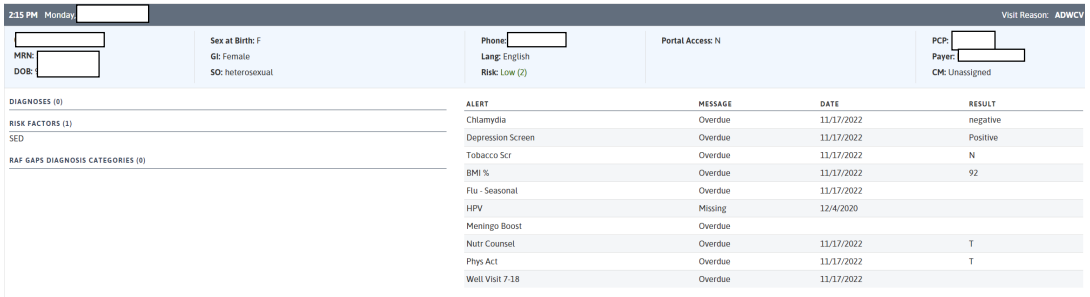
Clinical guidelines and care gaps: Consider which preventive and maintenance services could be addressed more reliably using PVP, including those in your EHR’s care gap module. The Pre-Visit Planning: Leveraging the Team to Identify and Address Gaps in Care resource provides a more complete list of preventive services for adults and children. Figure 12 provides an example of how your EHR might be able to support flagging patients overdue for specific preventive services
FIGURE 12: PRE-VISIT PLANNING REPORT DETAILING OVERDUE SERVICES FOR AN ADOLESCENT
Leveraging sick visits for preventive activities: Start by using a pre-visit planning process to identify patients who could benefit from adding well-care activities. An age-based well-child visit cheat sheet can help staff quickly determine priority items such as developmental and behavioral health screenings, immunizations, and other preventive services. Missed appointments or care gaps should prompt the team to screen for health-related social needs, like transportation challenges, that may be contributing to these gaps.
When pre-visit planning reveals outstanding well-care needs, schedule a longer appointment and code it as both a well-child and problem-focused visit. Beyond scheduled visits, staff can also look for preventive care opportunities during routine touchpoints, such as medication refill requests or phone calls with families.
The American Academy of Pediatrics and the American Academy of Family Physicians recommend that children with mild illnesses receive vaccinations on schedule. Importantly, there is no health benefit to waiting to vaccinate if a child has a mild illness. In fact, it is vital that children receive recommended vaccines on time so they are protected against serious disease.
Children can still be vaccinated if they have:
- A low-grade fever,
- A cold, runny nose, or cough,
- An ear infection (otitis media),
- Mild diarrhea.
The PCP and BHP alternate every 2 week visits with Mr. Engle over the next 3 months. At his 6 month checks for diabetes, Mr. Engle's A1c has improved to 8.5 and he reports no episodes of hypoglycemia. He reports 2 regular meals/day and spending time outside of the house with a neighbor. His Phq-9 score is now 5. His affect is brighter. He reports minimal side effects from his new SSRI.
PVP checklist: A generic PVP checklist to be completed by the medical assistant (MA) or LVN at least one to three days before the appointment is provided in Figure 13. Most EHRs will have a health maintenance module that identifies what preventive care is due, but a printed or digital checklist provides a starting point for ensuring key steps aren’t missed.
FIGURE 13. PVP PLANNING CHECKLIST ITEMS TO ADD FOR PEDIATRICS
Checklist Domain |
Checklist Item |
|---|---|
General |
|
Room readiness |
|
Medical record review |
|
Assessments Needed |
|
Care Gaps |
|
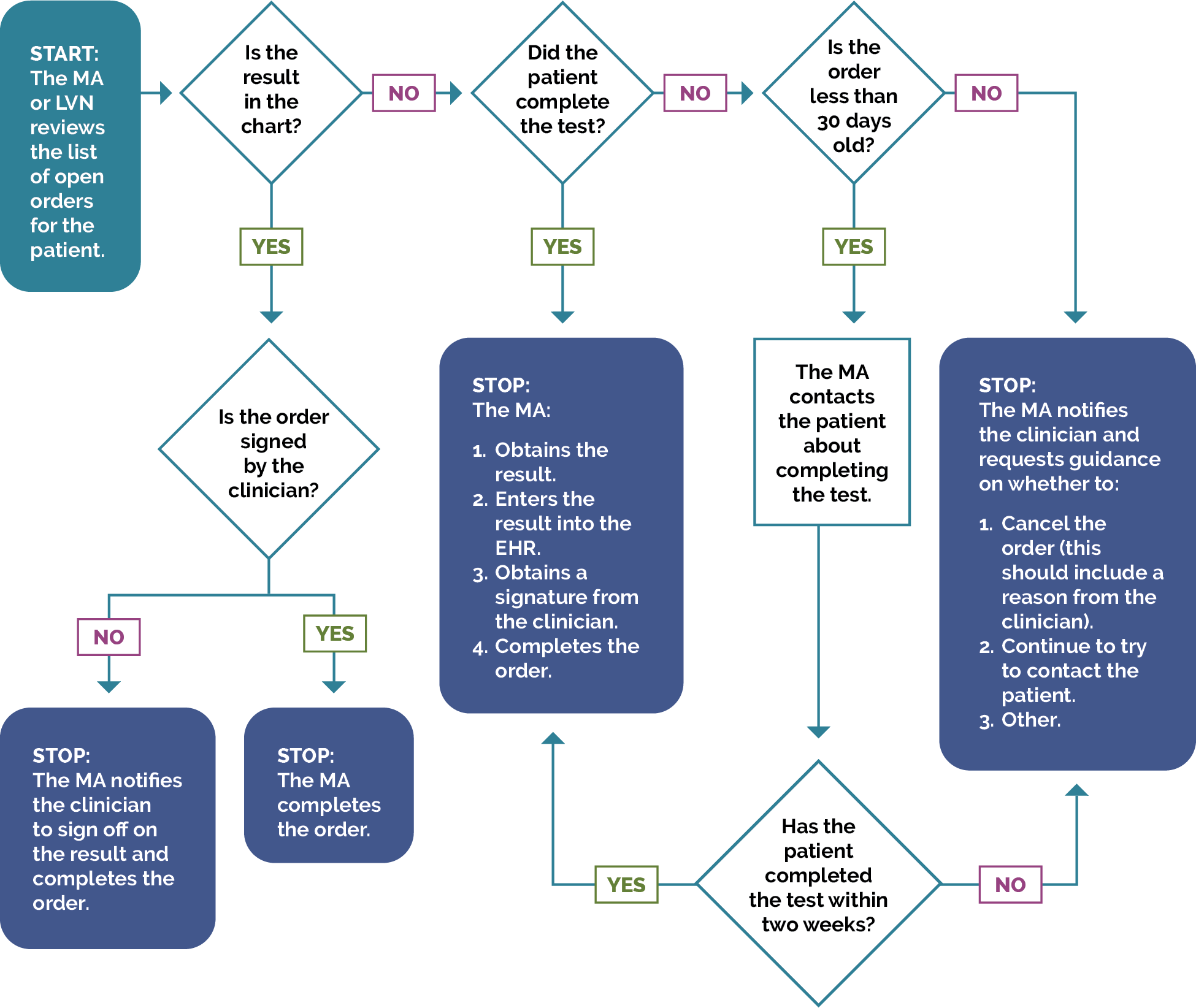
Chart scrub: An example chart scrub process led by the MA or LVN as part of PVP for completing open orders is detailed in Figure 14.
FIGURE 14: EXAMPLE CHART SCRUB PROCESS FOR OPEN ORDERS
Daily huddles: Design or redesign the team’s daily huddle so the care team can review prioritized action items for the list of patients scheduled to come and any further follow-up for patients seen in the previous days. For more information, see Care Team Daily Huddle Process.
The Centers for Excellence in Primary Care resource on Healthy Huddles includes tools, a video, and examples around how pre-visit planning flows into the daily huddle process, including a “Healthy Huddles Warm-Up,” which can help MAs prepare for huddles.
Patients requiring special considerations: Ensure that the PVP includes a process to flag for the care team:
- Patients requiring special attention, such as those with outstanding well child activities, chronic conditions, complex needs, and recent ED visits or hospitalizations, or who are in foster care.
- Patients who need extended time or additional services during their visit (e.g., multiple vaccinations needed, translation services, mobility assistance, and screenings).
Detailed clinical workflows: Clinical workflows should be updated to describe at which step in the PVP or the patient visit a care team member will address a specific gap in care with the patient.
FIGURE 15: EXAMPLE WORKFLOW FOR SCREENING FOR ADVERSE CHILDHOOD EXPERIENCES
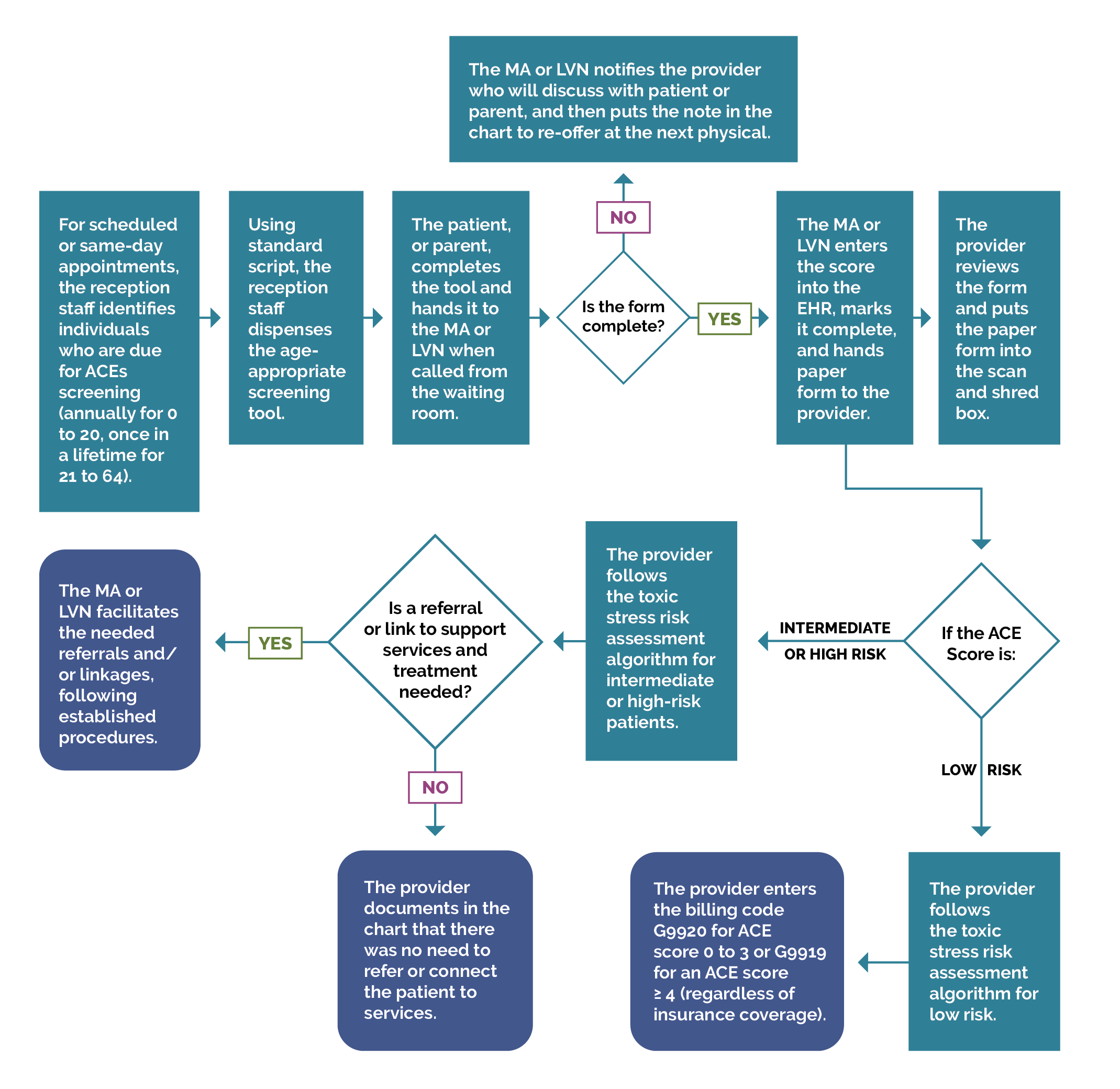
This example workflow for ACEs screening depends on reception staff and MAs and LVNs as core team members for ensuring the patient gets screened when they are in-office and facilitating referrals afterwards.
Planning for care after the visit: Effective PVP includes scheduling pre-visit labs and other diagnostics at the end of the current visit and care coordination for referrals for services not available at the practice. See Key Activity 13: Coordinate Care for more information. Confirm that the patient understands the purpose of any follow-up care. Ensure that the appropriate after-visit summary has been provided at the conclusion of the visit.
Example: Marin Community Clinics has their hospital-based Comprehensive Perinatal Services Program (CPSP) workers schedule both the newborn visit and three-week appointment with the PCP before the birthing person and baby are discharged from the hospital. Medical assistants have been trained to recognize this workflow to avoid confusion that could lead to mistakenly canceling the three-week appointment. If the newborn visit is kept, subsequent appointments are scheduled before the patient checks out. If the appointment is missed, medical assistants follow a missed appointment workflow. The encounter is labeled as “Well-Check No-Show” and categorized as high-risk.
Tip: The American Medical Association (AMA) has an online guide for implementing pre-visit planning, which includes forms, templates and other resources. Limited published literature on the effectiveness of pre-visit planning in the pediatric setting exists, however Samaan, et al. published this study in Pediatrics in 2016: Implementation of a preventive services bundle in academic pediatric primary care centers.
3. Test and implement workflow changes.
Suggested team member(s) responsible: Implementation team or QI team, QI lead with care team staff (as appropriate for the WCV activity of focus) and patients their families.
Checklist:
- Develop workflows and protocols for your PVP process. Tip: Test important changes with one or two care teams before considering rolling out the change more broadly at the practice.
- Update documentation and create a training plan. For example, conduct an MA refresher training every 6 months on the PVP. If they have difficulty, have them retake the training with a different MA and monitor closely until they achieve competency.
- Provide staff talking points on the importance of vaccines (Key Activity 11: Provide Caregiver Support to Address Vaccine Hesitancy), as well as the importance of well-child visits and what to expect. HealthyChildren.org has information for parents about each well child visit that can be modified to form talking points for staff.
Consider extending these workflows and protocols to implement WCV activities during other visit types as well, including nonurgent follow-up visits for chronic conditions (e.g., asthma, ADHD). Tips:
- When conducting preventive screening during an acute visit, rooming staff should gauge patient readiness for screenings (“read the room”) and involve families in decisions about whether to do the screening. Empower staff to prioritize patient needs when time or illness limits preventive activities.
- Ensure your practice is correctly coding for concurrent WCV and valuation and management (E/M) services to maximize reimbursement.
Peer Example: Children’s Hospital Primary Care Clinic (CHPCC) at Vanderbilt used a people-process-technology approach (electronic up-to-date status indicators, standardized scheduling for acute visits based on status, and a dedicated nurse practitioner) to increase WCV completion at acute visits.
4. Establish a process to review and update PVP workflow.
Suggested team member(s) responsible: Care team with quality improvement manager.
Identify staff responsible for reviewing and updating the PVP process at least annually to incorporate the latest clinical guidelines and any improvements that the care team has developed.