
Building the Foundation
Introduction
Why data quality and reporting matters
Collecting high-quality data is essential for quality improvement, population health management and value-based care. [1][2][3][4] Performance measurement is the tool for monitoring and identifying opportunities to improve patient care by identifying care gaps and health inequities. Consistently tracking and reporting on a standard set of quality measures will allow you to understand the current state of a patient population, identify any care gaps or health disparities, and monitor improvements over time.[5] Reporting on standardized measures is also used to monitor care across sites and align payment with achievement of quality.
Collecting and using racial and ethnic data allows practices to identify and respond to inequities and disparities in care, and is fundamental to population health management and to promoting health equity. High-quality data segmented by race and ethnicity can inform targeted performance improvements in access, continuity, preventive care and care management that ultimately lead to more equitable care and improved health for your patients.
Improving data quality and reporting allows for positive impact in a variety of settings. By having data informed decision making, practices can make decisions that accurately reflect the current state of the practice. It provides a way to measure and ensure that:
- Members of care teams are being deployed effectively to ensure patient health needs are addressed.
- A physician’s panel is adequately sized in accordance to patient complexity and need.
- Key performance indicators are being met.
- Reimbursement is maximized so that pay for performance targets are met or exceeded.
For talking points to help staff and other stakeholders understand the importance of the change, see Building the Foundations: Talking Points for Engagement. Understanding the bigger picture helps care teams move from viewing population health areas as isolated requirements to seeing them as part of a long-term strategy for improving patient outcomes and practice sustainability.
How to use this guide
These guides are designed to be helpful as part of an organized quality improvement strategy, with the goal of supporting substantive cultural, technological and process changes that improve population-based care. Enterprising practices can take on this work on their own with internal champions, including quality improvement, clinical and program leaders. They may be supported by practice facilitators, coaches or external consultants who help primary care practices improve population health management. The central content of the guide is organized into a sequenced set of evidence- or best practice-based key activities that, when applied to your local clinical context, can lead to improved ways of working. An onsite leader or champion can motivate peers and adapt the content in this guide for your setting, size, patient population and context.
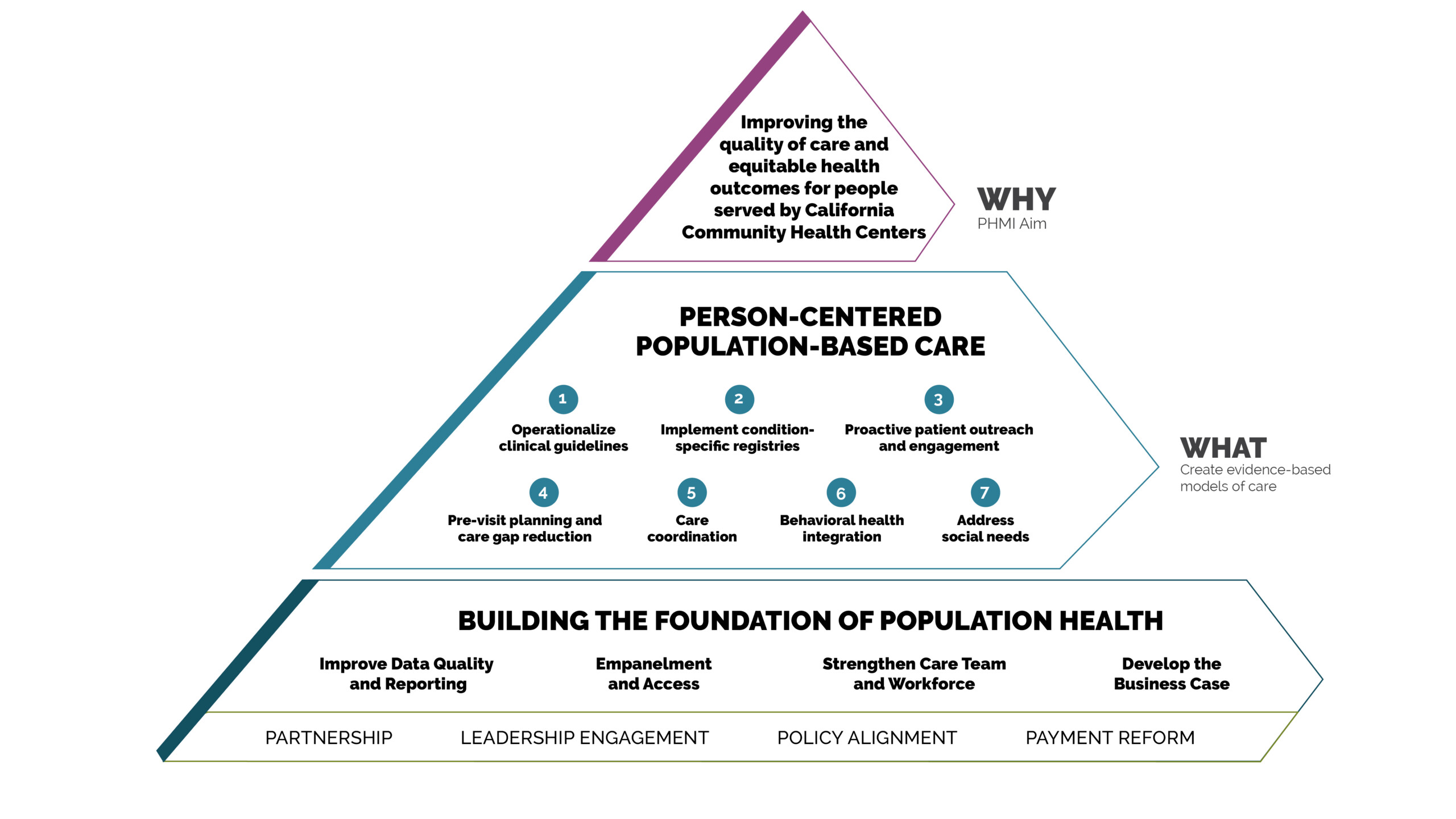
What the data quality and reporting guide offers
In preparation for reporting, this guide offers steps and activities to ensure your practice is capable of reporting valid and reliable data for selected population health measures. The measures covered in this guide consist of seven Healthcare Effective Data and Information Set (HEDIS) measures designated as core measures by PHMI and 10 supplemental measures. All measures use standard HEDIS definitions and are aligned with DHCS Quality Strategy and Medi-Cal Managed Care Accountability Set and Alternative Payment Methodology (APM) 2.0. Using external HEDIS data to analyze patient populations can provide direction and focus on how to improve the health of your entire population, including those assigned but not yet seen.[6]
If your organization is interested in Going Deeper, additional content is available on using data from health information exchange and community information exchange platforms to create business intelligence tools that offer more robust, timely and holistic insights into service utilization and health outcomes. Finally, this guide covers data quality and reporting topics On the Horizon, such as using new technologies like remote patient monitoring and artificial intelligence to design, implement and optimize customized interventions to improve health for high-risk segments of the population.
HEDIS is a tool created by the National Committee for Quality Assurance (NCQA) to collect data about the quality of care and services provided by health plans. It consists of a standardized set of more than 90 healthcare performance measures across multiple domains. It is one of healthcare’s most widely used performance improvement tools. You can learn more about HEDIS from NCQA.
Who needs to be involved in the work
This guide is ideal for staff who will play a role in data governance and reporting within your practice. They might include:
- An executive sponsor.
- A clinical informatics or analytical staff member.
- A quality improvement coordinator.
- A clinical contact who can provide expertise on the clinical data feeds.
Regardless, all staff within the practice have a role to play in performance measurement. Part of the data governance and reporting team’s role will be to ensure that all staff understand the measures and protocols for data reporting, and that they follow through so that you’re able to report and use high-quality data.
The importance of high-quality data in population health
Effective population health management requires that a practice’s data is accurate, reliable, comprehensive and accessible to care teams. Both your individual-level and population-level data should be:
- Accurate, reliable and comprehensive: Data should be high-quality and inclusive of demographic and social characteristics of your patient population. Validation and reconciliation processes will help you to achieve this.
- Tracked over time: Your practice should be able to track clinical measures over time. This is a demonstrated success factor for implementing population health management and patient-centered care. [7][8][9][10]
- Inclusive of all patients: Data should include the entire patient population— both those who have engaged in care (i.e., had a visit) and those who have been assigned to a practice by health plans but have not yet engaged in care. Accessing data and understanding the health needs of the entire patient population will require accessing external datasets as well as internal data.
- Visible to care teams: High-quality data should be visible to care teams at the point of care. This allows teams to more easily identify opportunities for improvement and to develop and monitor targeted interventions that address the care needs of the whole patient population the team is serving.[11] Additionally, having trusted, accurate population-level measures visible can engage and motivate providers and staff as they adopt a population-based perspective to care delivery for their patient panels.[12][13]
Endnotes
- Mitri J, Gabbay R. Understanding Population Health Through Diabetes Population Management. Endocrinol Metab Clin North Am. 2016;45(4):933-42.
- Powell A, Rushmer R, Davies H. Effective quality improvement: some necessary conditions. British Journal of Healthcare Management. 2009;15(2):62-8.
- Rodriguez HP, Ivey SL, Raffetto BJ, Vaughn J, Knox M, Hanley HR, et al. As good as it gets? Managing risks of cardiovascular disease in California’s top-performing physician organizations. Jt Comm J Qual Patient Saf. 2014;40(4):148-58.
- Wise CG, Alexander JA, Green LA, Cohen GR, Koster CR. Journey toward a patient centered medical home: readiness for change in primary care practices. Milbank Q. 2011;89(3):399-424.
- Geboers H, Grol R, van den Bosch W, van den Hoogen H, Mokkink H, van Montfort P, et al. A model for continuous quality improvement in small scale practices. Qual Health Care. 1999;8(1):43-8.
- Rodriguez HP, Ivey SL, Raffetto BJ, Vaughn J, Knox M, Hanley HR, et al. As good as it gets? Managing risks of cardiovascular disease in California’s top-performing physician organizations. Jt Comm J Qual Patient Saf. 2014;40(4):148-58.
- Geboers H, Grol R, van den Bosch W, van den Hoogen H, Mokkink H, van Montfort P, et al. A model for continuous quality improvement in small scale practices. Qual Health Care. 1999;8(1):43-8.
- Rodriguez HP, Ivey SL, Raffetto BJ, Vaughn J, Knox M, Hanley HR, et al. As good as it gets? Managing risks of cardiovascular disease in California’s top-performing physician organizations. Jt Comm J Qual Patient Saf. 2014;40(4):148-58.
- Solberg LI, Stuck LH, Crain AL, Tillema JO, Flottemesch TJ, Whitebird RR, et al. Organizational factors and change strategies associated with medical home transformation. Am J Med Qual. 2015;30(4):337-44.
- Wise CG, Alexander JA, Green LA, Cohen GR, Koster CR. Journey toward a patient centered medical home: readiness for change in primary care practices. Milbank Q. 2011;89(3):399-424.
- Matthews MR, Miller C, Stroebel RJ, Bunkers KS. Making the Paradigm Shift from Siloed Population Health Management to an Enterprise-Wide Approach. Popul Health Manag. 2017;20(4):255-61.
- Powell A, Rushmer R, Davies H. Effective quality improvement: some necessary conditions. British Journal of Healthcare Management. 2009;15(2):62-8.
- Rodriguez HP, Ivey SL, Raffetto BJ, Vaughn J, Knox M, Hanley HR, et al. As good as it gets? Managing risks of cardiovascular disease in California’s top-performing physician organizations. Jt Comm J Qual Patient Saf. 2014;40(4):148-58.