
Building the Foundation
Version 3 – June 2026
Introduction
Why empanelment matters
Empanelment is the act of attributing individual patients to individual primary care providers (PCPs) and care teams with sensitivity to patient and family preferences.[1] This process of attribution transforms the entire population of patients served by a primary care practice into distinct subpopulations that can be managed by clearly identified primary care providers and care teams.
Designating groups of patients to be cared for by individual providers and care team functions as a cornerstone for high-performing primary care and population health management.[2] By developing clearly defined subpopulations, empanelment enables:
- Population management by care teams.
- Continuity and the development of therapeutic, trusting relationships between the care team and the patient, an essential component of effective primary care.
- Provider/visit supply and demand management.
- Data-driven decision making about access, schedule templates, population health metrics, and clinical redesign.
- Care team accountability for results.[3]
Creating a population health management approach in primary care requires a cultural shift towards proactive population-level monitoring and intervention while also maintaining the quality of individual patient interactions and patient care. Empanelment is a key driver of this cultural change: organizing patients into groups that primary care teams can take responsibility for managing is both a foundation and an ongoing goal of effective population health management.
Optimizing empanelment requires additional operational changes beyond the organization of patients into subpopulations. The shift from addressing immediate needs with provider visits to a focus on managing population health with proactive and preventive care is facilitated by:
- Right-sized panels.
- Patient choice of PCPs.
- Empanelment-aware scheduling that balances continuity with promptness.
- Messaging systems that foster continuity.
- Tools that support responsiveness to patients’ needs, even for patients without appointments.
For talking points to help staff and other stakeholders understand the importance of the change, see Building the Foundations: Talking Points for Engagement. Understanding the bigger picture helps care teams move from viewing population health areas as isolated requirements to seeing them as part of a long-term strategy for improving patient outcomes and practice sustainability.
How to use this guide
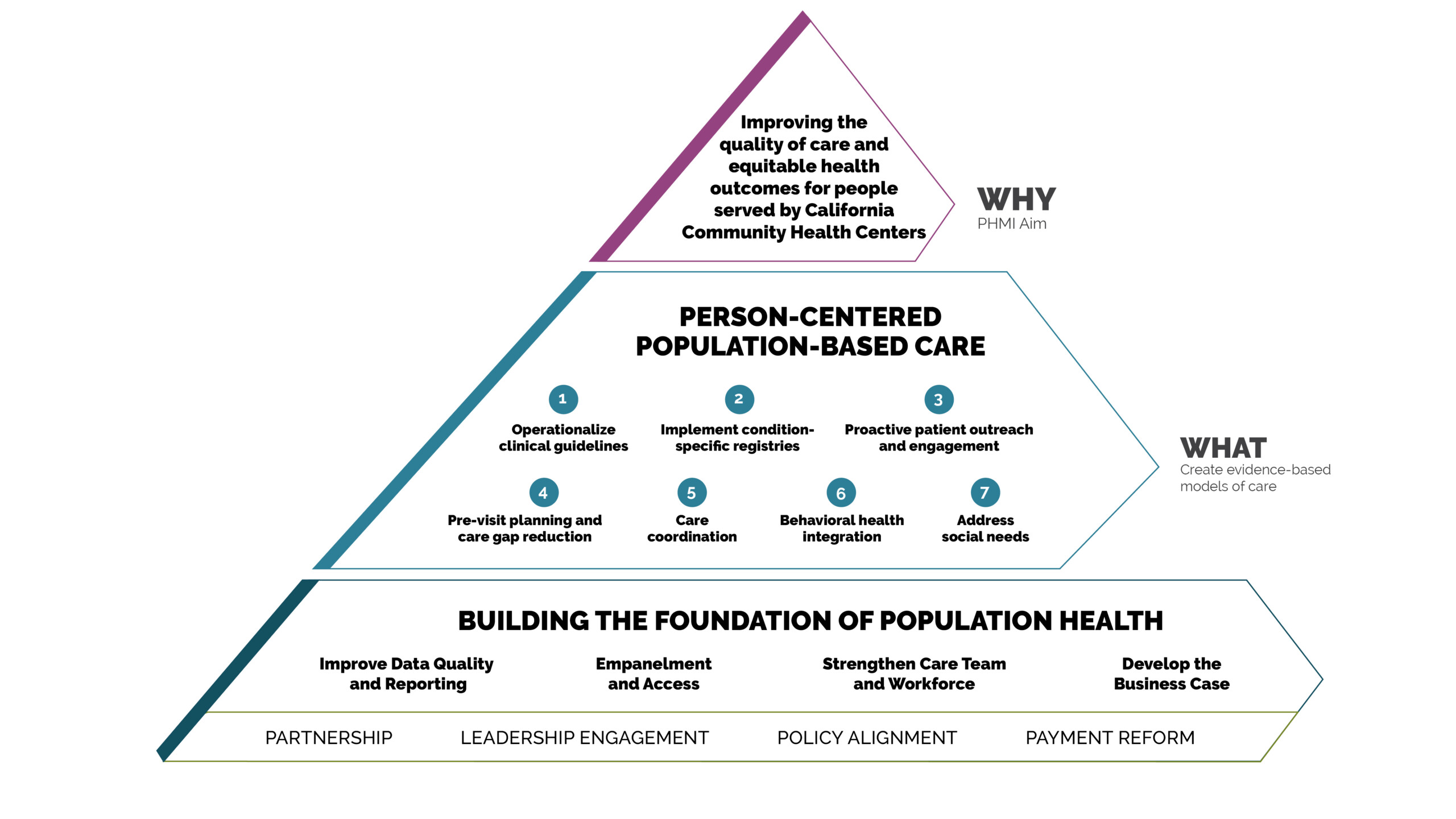
These guides are designed to be helpful as part of an organized quality improvement strategy, with the goal of supporting substantive cultural, technological and process changes that improve population-based care. Enterprising practices can take on this work on their own with internal champions, including quality improvement, clinical and program leaders. They are often supported by practice facilitators, coaches or external consultants who help primary care practices improve population health management. The central content of the guide is organized into a sequenced set of evidence- or best practice-based key activities that, when applied to your local clinical context, can lead to improved ways of working. An on-site leader or champion can motivate peers and adapt the content in this guide for your setting, size, patient population and context.
What the empanelment guide offers
This guide offers technical and relational guidance on how to implement empanelment, which involves attributing individual patients to individual primary care providers and care teams with sensitivity to patient and family preferences.[4] The guide addresses key considerations for empanelment, including change management, staffing, organizational policies and procedures, and health information technology requirements, as well as concrete steps for conducting initial patient assignment and ongoing population management using panel-level data.
For organizations interested in Going Deeper, additional content is available on the relationship between empanelment and patient-centered access, as well as empanelment and outreach to members assigned by managed care who have not yet been seen by the practice. Finally, the guide covers empanelment topics On the Horizon, such as the impact of behavioral and social health integration, virtual care, and artificial intelligence tools for managing supply and demand.
Who needs to be involved in the work
Empanelment is foundational to primary care population health management, and should be adopted by any practice working to strengthen proactive and systemic health improvement for the population they serve. Investing in change management is critical for success, and proactively collaborating with providers and care teams throughout the empanelment process is an essential foundation for sustainable, team-level accountability and engagement in panel-based population health.
Like any significant practice change, implementing empanelment requires engaged multidisciplinary leadership to succeed. Critical roles needed to lead the implementation of empanelment include:
- Clinical leadership, like a chief medical officer, to design and facilitate provider engagement in initial panel assignment and ongoing panel management activities.
- Health information technology (HIT) leadership, such as a chief technology officer or chief clinical informatics officer, to identify and support analytics staff to collaborate on developing the necessary reports and HIT infrastructure for initial empanelment and ongoing empanelment maintenance.
- Quality improvement (QI) leadership, like a QI director or manager, to partner with clinical and HIT leadership to support the cultural changes and process improvement required to implement and sustain empanelment.
- Financial leadership, like a chief financial officer, to collaborate in determining how the organization will resource the key functions of a panel manager, including whether to redeploy existing staff or develop and hire a new staff position.
- Patients and families should serve as critical partners in implementing and sustaining empanelment in order to optimize relationship-driven care. Partner with patients to collaboratively design effective approaches for both initially identifying and changing PCPs, as well as addressing tensions between access and continuity in ways that are acceptable to your local community.
Investing in change management is critical for success, and proactively collaborating with providers and care teams throughout the empanelment process is important for sustainable team-level accountability and engagement in panel-based population health. Leaders may use this guide to gain actionable insights and ideas to address the technical, cultural and human elements of this transformational approach to managing a primary care population.
Endnotes
- Brownlee B, Van Borkulo N. Empanelment: Establishing Patient-Provider Relationships. Seattle: Safety Net Medical Home Initiative; 2013 [cited 2023 July 13]. Available from: https://www.safetynetmedicalhome.org/sites/default/files/ Implementation-Guide-Empanelment.pdf.
- Bodenheimer T, Ghorob A, Willard-Grace R, Grumbach K. The 10 building blocks of high-performing primary care. Ann Fam Med. 2014;12(2):166-71.1.
- Shah A. Knowledge Building Session:Empanelment. Seattle: Safety Net Medical Home Initiative; [September 11, 2023]. Available from: https://www. safetynetmedicalhome.org/sites/default/files/Webinar-Empanelment.pdf.
- Brownlee B, Van Borkulo N. Empanelment: Establishing Patient-Provider Relationships. Seattle: Safety Net Medical Home Initiative; 2013 [cited 2023 July 13]. Available from: https://www.safetynetmedicalhome.org/sites/default/files/Implementation-Guide-Empanelment.pdf.