
Building the Foundation
Version 3 – June 2026
Key Activity 4: Develop ongoing strategies for managing empanelment and population health.
Empanelment as a population health management strategy requires ongoing attention and maintenance with respect to both accuracy and integrity of panel size and assignments, as well as team-level use of panel data for panel management.
1. Use continuous quality improvement methods to check and adjust empanelment policies and procedures.
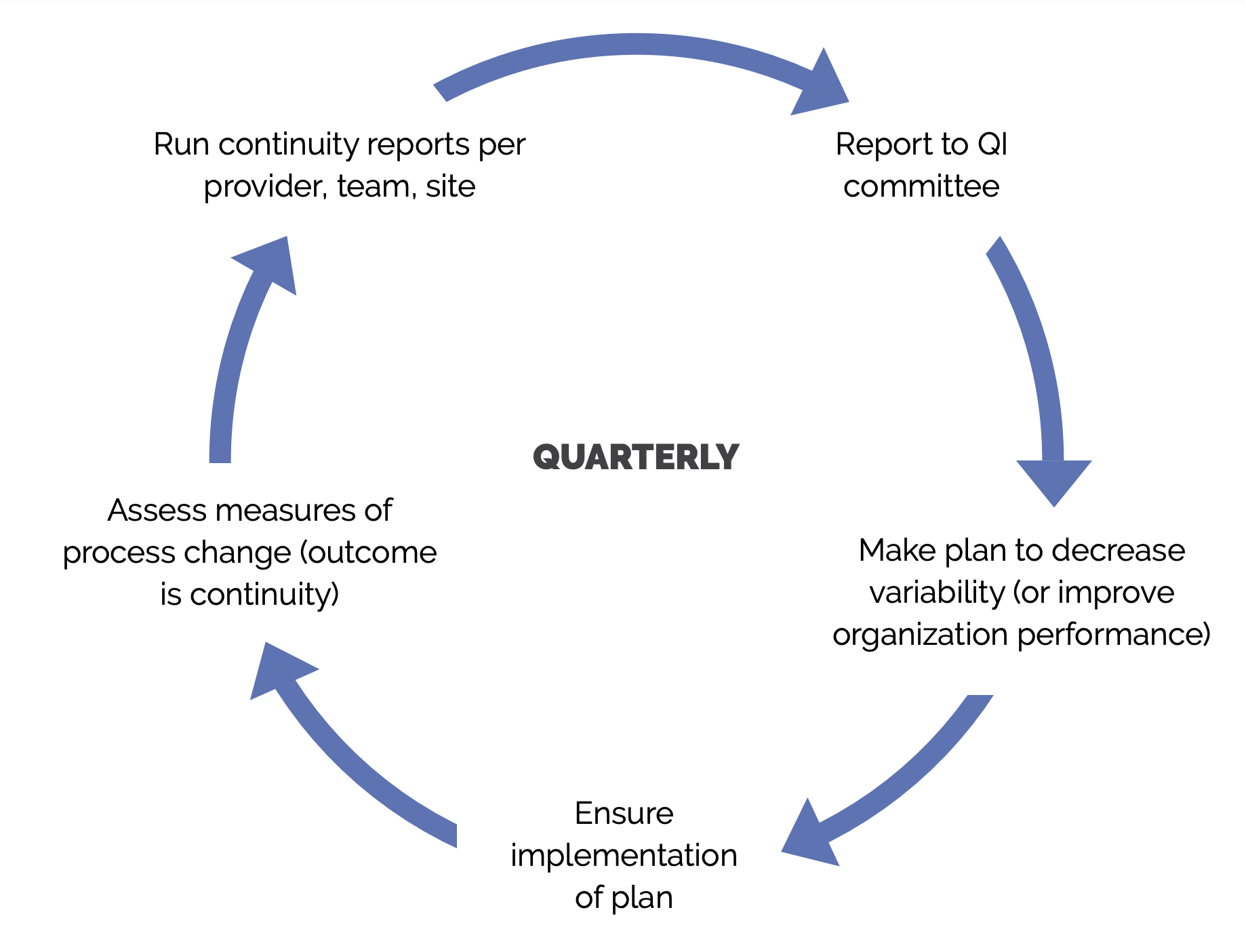
Improving relational continuity is one of the primary goals of empanelment; measuring both provider and patient continuity drives the improvement of relational care. Although a continuity goal of 100% is not realistic, as some appointments will inevitably occur with providers besides the patient’s own PCP, practices should set a continuity goal that reflects their care environment, including patients’ need to balance continuity with promptness of care.
Higher rates of both continuity and appropriate schedule utilization are likely to increase provider satisfaction, improve quality metrics and diminish avoidable excess utilization, but are hard to achieve and sustain. A practice with part-time PCPs, low chronic disease burden, and a higher percentage of non-infant children may be able to produce good results with a lower (~ 70%) continuity rate. In comparison, a practice with mostly full-time providers and many patients requiring frequent visits for chronic conditions might require an 85% or greater continuity rate to deliver good results. A goal of 80% is a reasonable place to start for most practices.[1]
Retention of patients at the practice improves continuity at a system level. Retention is difficult to measure for the whole population since many patients only need infrequent primary care interactions, and their retention may be unknown for a year or two after their last interaction with the practice. Retention, however, can be measured on a shorter timeline for subpopulations expected to have frequent clinical contact with the practice, such as infants, pregnant people and patients with some chronic conditions.
FIGURE 3: CONTINUITY AND RETENTION PERFORMANCE IMPROVEMENT[2]
2. Use panel data and registries to proactively contact, educate and track patients by disease status, risk status, self-management status, community, and family need.
Once practices have established empanelment, care teams can use the data available for their panel to monitor care gaps, conduct proactive outreach and engage the patients on their panel for preventive and chronic disease care. This set of activities is particularly important for patients with high or rising risk who can be grouped into populations with shared traits for engagement in relevant care activities.[3] Using panel data for these outreach and care engagement activities is essential to effective population health management overall.
Endnotes
- National Association of Community Health Centers. Population Health Management Empanelment Action Guide. Bethesda: NACHC; 2022 [September 11, 2023]. Available from: https://www.nachc.org/wp-content/uploads/2022/06/Empanelment_PopHealth-Mgmt_Action-Guide-April-2022.pdf.
- Developed in 2022 through the PHMI empanelment design team process.
- Brownlee B, Van Borkulo N. Empanelment: Establishing Patient-Provider Relationships. Seattle: Safety Net Medical Home Initiative; 2013 [cited 2023 July 13]. Available from: https://www.safetynetmedicalhome.org/sites/default/files/ Implementation-Guide-Empanelment.pdf