
Building the Foundation
Version 3 – June 2026
Key Activity 3: Conduct initial patient attribution and supply and demand balancing.
To develop provider panels, the practice must conduct initial patient attribution, as well as develop a process for regular review and adjustment to ensure there is a balance of supply and demand. Managing supply and demand requires opening and closing panels based on capacity. A simple count of the patients in a panel will too often overestimate or underestimate the level of effort required to deliver primary care to the patients in the panel. Capacity management will be greatly facilitated through use of a dashboard that clearly and simply shows productivity, relative access, and the two continuity measures (patient-perspective continuity and provider-perspective continuity), together with the number of patients in the panel. A well-functioning dashboard should be a prerequisite to any attempt to weight the panels.
1. Attribute all patients to a provider panel and confirm attribution with providers and patients; review and update panel attribution on a regular basis.
Initial empanelment methods are well described, and while the methods require close attention to detail, they do not require any sophisticated calculations.[1] Empanelment methods should be used when there is either no PCP/patient association or when a reset is needed to respond to low accuracy of existing PCP/ patient associations.
Initial empanelment should account for patient and family preferences and established PCP relationships, although gathering every patient’s preference individually is not generally practical. General communication at the time of initial empanelment or reset with a clear and explicit process for changing PCPs is generally adequate for patient participation in empanelment.
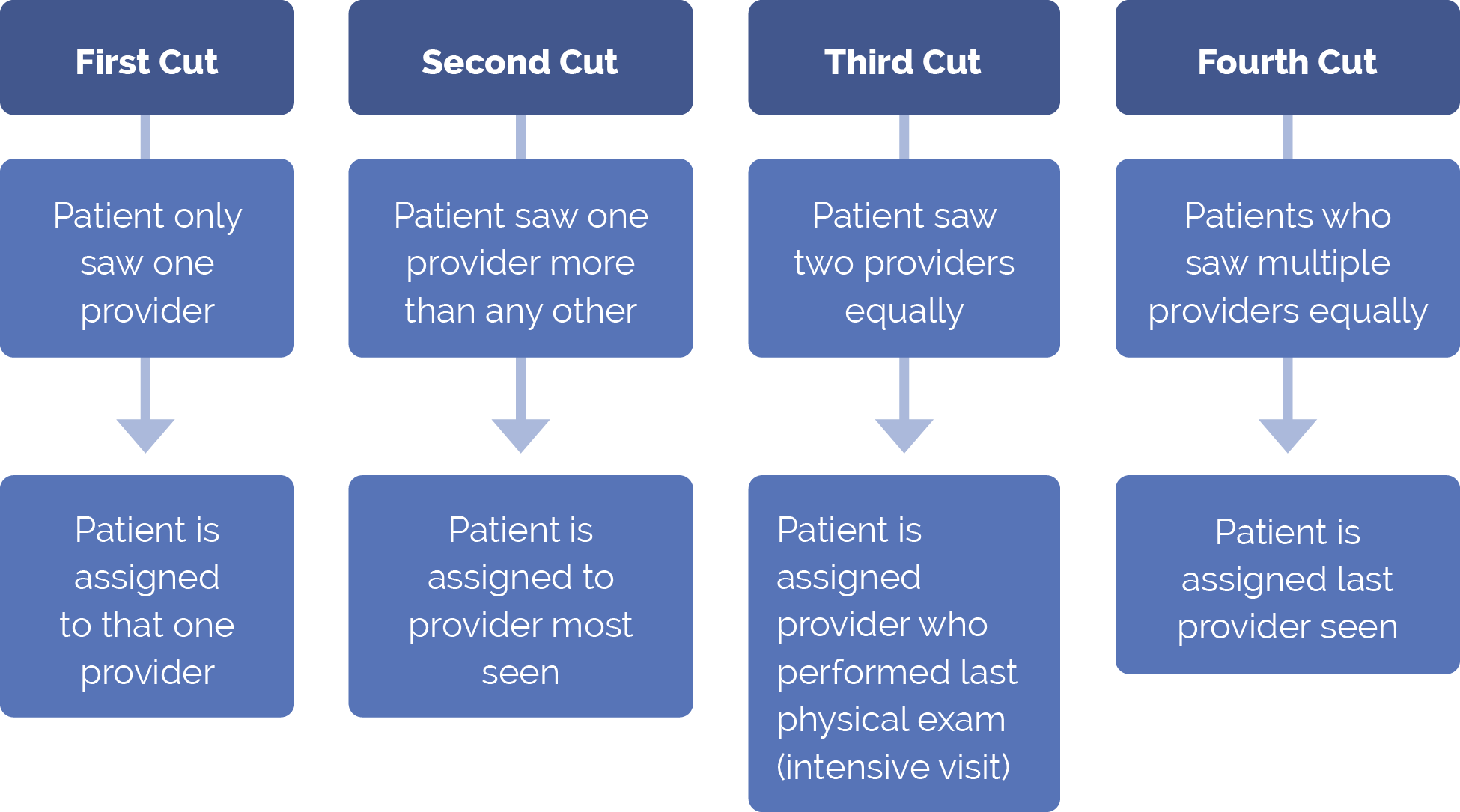
Two common methods for initial or reset empanelment are the four-cut method and the one-cut method.
Four-Cut Method
The four-cut method is a set of four sequential processes. Any patients not empaneled per an earlier process are subject to the next process. The sequential processes are conducted using appointment data from the past year:
FIGURE 1: FOUR-CUT METHOD
Single-Cut Method
In the single-cut method, each visit in the prior two years is weighted, and the patient is empaneled to the provider with the highest sum of the weighted visits.
2. Right-size panels according to provider capacity.
Once assigned, practices should develop and implement a process to keep panels right-sized to provider visit supply. This process may include managing demand by weighting panels and closing panels to new patients, as well as increasing supply by optimizing team roles and creating new and more efficient ways to deliver care. Patient preference and movement between panels should also be considered, as described below.
The Importance of Panel Size
Determining the appropriate panel size is important for:
- Accurately managing supply and demand.
- Getting support for empanelment from PCPs by establishing shared parameters for fair and rational workload distribution.
- Ensuring adequate access for the population served.
Calculating Panel Size
Panels should be calculated by dividing the total time that any given provider will work based on provider agreements of clinical sessions per week and weeks per year of paid time off (PTO) by the average number of visits per patient per year. In addition to this simple calculation, practices may want to calculate weighted panel size in order to account for variation in demand between patients.
Determining New Patient Slots Per Provider[2]
FIGURE 2: PANEL FULLNESS AND NUMBER OF NEW PATIENTS
Percent Fullness of Panel |
Number of New Patients per Session14 |
|---|---|
<25% |
5 |
25-50% |
4 |
50-75% |
3 |
75-95% |
2 |
95-105% |
1 |
>105% |
0 |
The number of new slots in a provider’s schedule (per session or per week) should be closely related to the fullness of their panel. Some practices use patient weighting systems that account for patients who have not been seen in an extended period of time, e.g., all patients seen in the past eighteen months or two years are counted in the panel. When using this approach, practices should use the retention rate to determine how many new patients should be added. The number of new appointments is then determined by the percent fullness as shown in figure 2. Accounting for retention both improves accuracy of supply and demand projection and incentivizes PCPs to keep patients engaged and active at an appropriate level.
Patient Choice and Movement Between Panels
Managing and monitoring movement of patients between panels is an essential aspect of empanelment and should be overseen by the leader responsible for empanelment. Patient-requested PCP changes are especially critical, but there may be other reasons for panel churn, such as provider staffing changes or rebalancing of overloaded panels. Although panel fullness may impose some constraints, patients should be offered their choice of providers whenever possible, and should be informed of the internal PCP change processes and the goal of fostering positive, healing relationships. The change process should include clear documentation of the reason for the patient change request so that leaders may address patient concerns appropriately.
Endnotes
- Brownlee B, Van Borkulo N. Empanelment: Establishing Patient-Provider Relationships. Seattle: Safety Net Medical Home Initiative; 2013 [cited 2023 July 13]. Available from: https://www.safetynetmedicalhome.org/sites/default/files/ Implementation-Guide-Empanelment.pdf.
- Developed in 2022 through the PHMI empanelment design team process.